Tuesday, 23 August 2011

Fake Movie Reviews: Google Cars

The movie review below is based upon people from a true story that never happened. No animals were injured in the making of this movie review.

Daniel Grant Newton reviews, from Hollywood... well, not Hollywood, but a place like Hollywood.

"Like" of course is a relative term.

So loosely with the same general feel as Hollywood. But not really.

Well, the location of this review and Hollywood both have breathable air. Sort of.

So Daniel Grant Newton reviews from a place not not unlike Hollywood with sort of breathable air.

______


With an eclectic cast and blockbuster-style CGI, Peter Jackson's new movie Google Cars was an epic fail, blemishing a career of box office blitzers. Sort of like a pair of really nice brogues stepping in fresh King Kong poo.

Jeff Goldblum's performance of the psychotic computer hacker was both chilling and a heated performance. Unfortunately his lines were lukewarm, and the reasoning behind his distaste for society was temperate. Seeing such a great actor go to waste on a poor role left me both cold, and hot-headed, not knowing how to judge the temperature.

Kind of like sticking one foot in cold water and one foot in hot water, then sticking both feet in a bucket of temperate water and then trying to judge the temperature of the water. Or like reading this blog and trying to decide whether its genius and spontaneous, or rubbish incarnate and should really be edited. It's genius and spontaneous for those not sure.

Stephen Hawking's debut acting performance as the President of the United States was looked forward to by physics nerds alike, but in the end left much to be desired. He delivered his lines in a flat, monotone manner, with no hint of expression or intonation. Did not match the emotion that oozed from him in his tirade regarding the treatment of singing sensation Rebecca Black.

Chuck Norris played the hero of the film and was awesome. He was chosen to play this role after everyone else in contention mysteriously died from repeated roundhouse kicks to the head.  

Chuck Norris and some other guy.
Truly Norris' performance was brilliant, genius, inspired, loved, amazing, jaw-dropping fantastic, and I'm not just saying that because he has a fist poised to smash my head into pieces. He literally saved the film like Walker Texas Ranger saves the day.

Getting Lisa Simpson to play the romantic role for Chuck Norris here was a strange choice which turned out to be a master stroke, a work of art. At times her overacting was a little cartoonish, but since she is a cartoon character it is a little harsh on her to criticise her for that. It's like saying Steve Martin's performance in (insert movie) was very white.

It was good however to see her break out from her character in The Simpsons which has held her career back by typecasting her as a little yellow four-fingered girl. 

The Simpson's Hollywood Star ... didn't realise the MTV reality show Newlyweds with Jessica Simpson and Nick Whoever did so well.
 
A much more real performance was given by the real human actor Jaden Smith, playing Chuck Norris' son. Previously known as the 'Karate Kid', it is likely he'll be more known as 'boy who got stuck in hacked Google car' after this performance.

I was literally on the edge of my seat with his performance. Mainly because after coming back from the toilet during the movie I found someone had spilt most of their iced coffee on it whilst I was away.

In conclusion, the movie did not match the hype... and there was no hype surrounding the movie - so that says something! If I could create a time machine to go back and stop this movie from ever being made I would. Wait a second. Here's the missing piece for my time machine, the flux capacitor.

1/2 a star for the actual movie. 5 stars around my head from Chuck Norris' furry of punches. So overall I'm giving it 5 and a 1/2 stars out of 5.

Monday, 15 August 2011

Google Car Movie

I started reading this news release:

Google is driving head first into more controversy after revealing it has been testing its innovative hands-free car technology on California's roads.

It wasn't talking about keeping hands off the phone or the GPS. Alarmingly, it was testing cars driven with hands off the steering wheel.

Road safety experts were raising questions about the robot-driven cars after Google revealed it has logged more than 225,000km around the state – almost all of them on auto-pilot.

Now my first thoughts were that this would be handy (excuse the pun). I've always thought my hands got in the way when driving.

But then my mind switched to the next logical conclusion... car hacking.

Imagine this...

A computer hacker (played by Jeff Goldblum) is hacking cars across the USA and driving them at high speeds into symbolic structures, killing the passengers.

People are indescrimately being killed every hour on the hour, and the hacker states this will continue unless a large sum of money be transferred into an offshore account.

But the president (played by Antonio Banderas or Catherine Zeta-Jones or Stephen Hawking, or some other representative of a demographic who has not been president - a plot ploy to highlight to the audience that this event happens in the future) does not negotiate with terrorists, or bad drivers. The president will not bend on this hard line despite the insistance of their vice president (played by Jason Alexander).

Naturally, there are no records of the computer hacker, because they all have been deleted. And the country is on their knees.

So they turn to a "loose canon" computer genius (played by either Hugh Laurie, Hugh Grant, Hugh Jackman or Chuck Norris) fired by Google for objecting to the cars and "holding the company back" with his proposed safe guards.

This loose canon is the only guy who has the ability to hack past the hacker and into the computer network controlling the cars. The President calls the "loose canon" in despite his disregard for authority, and being labelled as "dangerous" by Jason Alexander's character.

It takes a lot to bring him in as he has lost the will to live, lost touch with society, and hasn't touched a computer since he was fired from Google. But when the president comes into his apartment, this loose canon's patrioism kicks in and he nervously starts cleaning up all the takeaway boxes readying himself to be taken to the White House by Airforce 1.

"I'm going to the White House," he excitedly squeals to the audience's amusement. This moment is then quoted by movie goers for a few years, and becomes to Hugh Laurie, Hugh Grant, Hugh Jackman or Chuck Norris, what "I'll be back" is to Arnie.

(Extra Fact: "I'll be back" is the exact opposite of what Arnie's wife said to Arnie. Snap!)

Then of course we find out he is the sole parent of a boy (played by Haley Joel Osment or Jaden Smith) and that his son has been trapped in his son's friend's mother's car.

We also discover that the computer hacking terrorist will drive the car off a bridge if he tries to stop him. But with 24 hours before the hacker will pull the plug on the country's electronic cars, our hero realises the hacker will kill his son anyway - and never planned to release him... in fact, the amount of oxygen in the car is being used up and he is only a few hours to override that car.

Plus he is being tortured with the Country and Western station on the radio. No kid should go through that!

The "loose canon" computer hacker (played by either Hugh Laurie, Hugh Grant, Hugh Jackman or Chuck Norris) then brings in an IT woman he once loved but broke up badly with to help him (played by Jessica Alba, Jessica Mauboy, Jessica Simpson, O.J. Simpson or Lisa Simpson).

This woman is the only one who can help him pull off this operation in that amount of time, even though they hate each other.

Inevitably sparks fly, but before they do, they pointlessly bicker quite a bit and suspend the obvious more pressing concern that the US is about to overrun by a mad computer hacking terrorist.

The audience then are left to wonder if these characters really do cut the time of task when they work together, or whether bringing in this IT woman was more of a cheap ploy by the script writer to add romance and character development into an action driven blockbuster.

Anyway, the IT woman then says something corny like "well, you could've at least called me in that time." And he says something corny like "I wanted to, every day since our break up. But I had this late power bill you see, and..."

Then they save the day, they capture the bad guy terrorist by trapping him in his get away car, the IT woman becomes the adopted mother to the boy of the loose canon, as well as the loose canon's girlfriend.

And the movie misses out on an Academy Award, but gets an above average rating on Rotton Tomatoes. And Jessica Mauboy makes a song with Jessica Alba and Jessica Simpson and Lisa Simpson that goes platinum.

It's almost too easy!

I don't know about you, but that was the logical progression for me when I discovered Google was making cars that drive themselves. Stay tuned (and subscribe to this beautiful blog) for more logical progressions.

Wednesday, 10 August 2011

Independent Thinking - the Skeleton Key to Knowledge (Part 3)


This third part has been a few weeks coming. The reason being is that I have been sick... or have I been sick? Yes, I have.

And I have also been hard working on ironing out the last few details before releasing my novel - The Last King of Shambhala - out very soon so I hope you have been saving your pocket money... or have I been working on my book? Again, yes, I have been.

Why do I keep questioning myself? Dammit, I did it again! That's three times I have questioned myself. (Is it three times?) Well, maybe it is because it's time to write the last in my independent thinking articles.

And while I'm letting you on what's been happening with me, I'd also like to mention that I have been to and just returned from the beautiful country of Canada...

A country where everybody plays a practical joke on all new arrivals and puts on dodgy US accents everywhere you go. They are SOOOO fake, they don't even sound that 'US-inese'.

Oh, and everyone drives on the wrong side of the road. The right side of the road being the wrong side of the road, and the left side of the road being the right side of the road.

Those Canadians are so crazy. But loveable.

And if you are a conspiracy theorist, check this out. When I arrived back in my home city, I was questioned (read: interrogated) by four different airport officials and watched much too closely until I left the airport. I'm not saying that it is because I've written a couple of articles on how to think differently and escape the mediocre manipulable mind (a.k.a. m.m.m. or mmm) ... but you can draw your own logical conclusions.

Actually the real reason "I'm not saying" is because of the Reptillian people monitoring my blog posts and farming human beings as 9-5 slaves.

No, I don't really believe in that rubbish... just clarifying there for the M.I.B., Desert Donkey Men and Aghartha Nazis monitoring my blog posts.

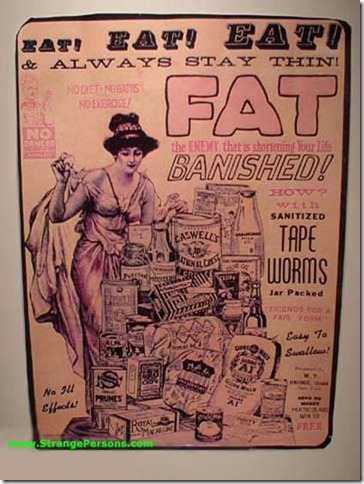
Anyway, back to the topic of the day. To start off this entry, I thought I'd share with you some very old ads. The 'facts', 'studies' and 'common knowledge' in these ads seem quite screwy in the lense of today's minds, but they make for a good laugh... Not to mention make you wonder how outdated our society's beliefs will be in a mere generation or two.


Hmmm... so, I guess a little has changed over the last 100 years then. And these photos neatly dovetail into my first topic of the day...

Society believes it (or doesn't), should you?

Peer pressure is an interesting thing. The obvious example is when we do something because everybody wants us to do it. But the less obvious example is adopting beliefs, often subconsciously, by following the pack. I think it's a safety in numbers thing, but it's not always a good thing. Just ask the ghosts of plankton.

One great experiment that looked at the conformity of human beings was conducted by Solomon Asch back in the 1950s. In the experiment people were shown lines and asked which lines were the same length.

The answer was very obvious, with two lines the exact length and the other two lines either much longer or much shorter. However, 76% of people got it wrong.

The reason being is that five people were sat in a row and asked by the examiner one after the other. The first four people were told (on the sly) to say the exact same answer - an obvious wrong answer - and then the final person was asked their answer and had no idea the others were all purposely choosing the same wrong answer. And the fifth person, despite their better judgement, went with the crowd.

You see, we have been trained to conform. It may be part of our prehistoric instinct, but society around us pushes us into manageable squares too.

(Again, there'll be people who tell you it is because of lizard people or a ruling body who want us dumbed down so we are more easily controlled ... but I'm not going to say that because I'm afraid of Desert Donkey Men.)

In the experiment, some of the participants answered incorrectly because they questioned their judgement, some feared the disapproval of the others in the group, and some didn't want to stand out even though they knew they were right.

Bottom line, they were pressured into the wrong answer. So do not - I'm speaking to YOU - do not blindly accept what everybody else believes. Be an independent thinker and blindly accept what I believe.

Do This Test - You can believe anything!

Look up on Google a topic you don't have much opinion about, but are interested in. Look up articles and videos created by people with two opposing opinions. Chances are both sides will make compelling cases. And the interesting thing is...

The more you delve into the topic, the more convincing facts, data and research you'll find for both sides.

Or listen to two great debaters battle it out. Often your opinion will swing to support whoever spoke last.

The truth is you can convince yourself of almost anything! You can convince yourself to believe anything. And therefore, you can actually CHOOSE your beliefs.

Beliefs are in fact just a thought that has been considered so much and 'proven' so many times in our heads that it becomes our truth.

If you decided you wanted to believe in fairies for example, just look up videos on YouTube supporting their existance, read accounts of good honest people who have seen them, and read articles explaining the scientific and historical research into fairies. Emerse yourself in all things that support the existence or at least possible existence of fairies.

Eventually you will believe in them - no matter how much resistance you have to the belief right now. And remember, according to the Peter Pan books, every time a child says "I don't believe in fairies", they kill a fairy.

So along with being a blog entry on independent thinking, this is also a public service announcement for fairies. I never thought I'd get to write those words!

My thoughts? Use your beliefs to your advantage!

I'm not going to tell you what you should believe, or what you shouldn't believe. I'm waiting until I take over the world before I do that.

But here's an idea. Choose beliefs that benefit you.

There have been some quantum physicists, motivational speakers, religious mystics and spiritualists alike who have said that our thoughts can directly affect and morph our world.

You may not believe that, but I am sure you can see when you look into it, you'll quickly see that changing your beliefs can be very powerful, and can GREATLY benefit you or hinder you in life.

Take physical pain for example.

With mere suggestion of healing, and the belief of followers, a Faith Healer can make someone who cannot walk because of the incredible pain in their legs, jump up and down and not feel a thing. This may not last when they get home - I don't know, but the belief they can get better can relieve them of the most terrible of pains.

When people are set up with suggestions like "this might hurt", or "as I do this you can probably feel your joints becoming more and more relaxed and flexible", the brain tells the body how to respond. And when you feel increasing relief, or increasing pain, created by the brain, your belief strengthens that the physical pain is changing. As your belief changes, the intensity of the pain or relief increases more and more.

If your belief can't relieve pain and illness, then what's a placebo?  (If your arse is smart you may answer that it is an alternative rock band from London.)

Earlier in this blog article I said I was sick just recently, and I had a physical example of this phenomena (sort of).

I was in such pain I could not do anything. I could not fall asleep, or even lie down. So I decided to distract myself with a very interesting documentary. As soon as my mind became completely focused on the documentary, the pain went completely... until the documentary finished and my brain again realised I was supposed to be in pain.

The pain was reliant on my focus on it. If you can focus wholly on something else, the pain cannot live... because the pain is all in your mind.

Another example of choosing your beliefs wisely - take the subject of confidence and self-worth perception

If you were confident (i.e. positively believed) you were a fantastic mate, you might stroll into a party, talk to every attractive potential mate in the room, and get at least one date at the end of the night. You would think of those who rejected you as "crazy", and achieved your goal of getting a date.

If you were not confident in your self worth, you would most likely talk to no attractive potential mates. And if you did, and were rejected, even if it was the first person you spoke to and they didn't really reject you - you would not try again.

BOTTOM LINE? Write down what you'd like, and write down what beliefs you need to achieve that goal. Then start fostering that belief.

So what can you know for sure?

There is only one thing you can know for sure. And that is that you are conscious in this very moment.

- You cannot know anything in this physical world is real. For those, like me, who have had a real lucid dream, your dream can feel to more real than your life. It can satisfy every sense vividly. So there is nothing to tell you you aren't hallucinating all of this.

- You cannot know that other people are real, unless you could enter their mind. They could be figments of your imagination or robots. I am both P.S.

- You cannot know your past is real, even a moment ago. You've probably had the experience where you remembered something to be so, been absolutely stuck on it, only to see a video of that moment and been wrong.

But more than that, you could have woken up in this world in this exact moment with all your memory having been created by scientists or by CIA agents... I'm just saying, it could happen. The past is only a memory.

- You cannot even know whether you can make choices. Our choices are the result of our preferences that are formed over events and genetics and maybe spiritual/personality make-up. If someone could create the exact make-up that is you, then that person would make the same choice.

So then, it is possible destiny or god or whatever has made you up to make a certain choice. Something people call destiny. And without knowing it, all your choices could have been made for you before you make them.

- Oh, but what if I go back in time and tell myself to choose another choice. Destiny or god or whatever probably made you want to go back in time so that you could choose another choice they wanted you to choose. You cannot escape it.

So only your awareness in this very moment is solid and real.

Okay, usual programming returns next blog entry. I hope you enjoyed this very different and long blog series.

Sunday, 17 July 2011

Independent Thinking - the Skeleton Key to Knowledge (Part 2)

Always question statistics and 'facts'!

As I've hopefully shown you in the previous blog article, you can easily manipulate opinion surveys, but what about cold hard factual statistics. Surely you can't change them... yes, you can.

Let's take for example the following made up statistic (I'll make it up since 67.92% of statistics are made up anyway):

33% of people with blue eyes catch the flu before they're four.

Okay, this is made up, but assuming it's true (or proports to be true), there are some unanswered questions that would put it in context. Without thinking like an independent thinker you'd say, "oh dear, blue eyed children are prone to catching the flu."

But is it really significant?

What percentage of people in general, for example, catch the flu in any given four year period? What about people with brown eyes or green eyes? Or people who are not between the ages of fetous and four?


And if that percentage is significant compared to these factors, what about all blue eyed people or all children indiscriminate of eye colour? Is it blue eyed children or just all blue eyed people? Or all children?

And who was recorded to get this statistic? How many people? Could this have been an anomaly in the area surveyed? Is it because they are blue eyed and children, or is there another reason for why these particular children get the flu?

Without this information the statistic is meaningless. It tells you nothing, yet it is manipulated statistics that get thrown around all the time to push opinions as facts.

Now this is a very harmless statistic to analyse. When the statistic has an emotional trigger involved, i.e. a topic people feel passionate about or enraged over, it is much easier for the population to accept. However, an independent thinker will never just accept blindly any statistic or 'fact'.


The Dangers of Dihydrogen Monoxide

A while ago there was a petition to ban a substance called Dihydrogen Monoxide (DHMO). If you are not familiar with it here are just some of the startling facts. The substance:

- is a major component of acid rain (called "hydroxl acid")
- greatly contributes to the "greenhouse effect"
- can be fatal if inhaled
- can cause severe burns
- erodes our natural landscape
- accelerates corrosion and rusting of metals
- has been found in tumors of terminal cancer patients

However, despite the danger, DHMO is often used:

- as an industrial solvent and coolant
- in nuclear power plants
- in the production of Styrofoam
- by athletes to improve their performance
- in many forms of cruel animal research
- as an additive in certain junk foods, and especially so-called "diet" food
- in distribution of pesticides (even after washing the produce remains contaminated)

When this research was submitted to the US government of the time with the signatures of many concerned people, the government didn't take the petition seriously.

Why? Because Dihydrogen Monoxide is another name for H20 (water).

But people didn't ask what DHMO actually was, they just listened to the facts, and became enraged as an 'educated' member of the public. This case study is very famous and makes a clear point about the importance of being an 'independent thinker' - a thinker that isn't led.


Putting your trust in scientists in white coats, doctors with stethoscopes, and the "common belief"

For most people, a strong influencer in shaping your own beliefs is the opinion of 'credible experts'. They've studied the subject, so they must know more than you, right? They possibly do, but it is still not a good reason to compromise your own judgement and follow blindly.

Take the Milgram Experiment as an example, conducted by Stanley Milgram some fifty years ago or so. In this experiment people were brought in to do an experiment that was suppose to test if you could accelerate learning by administrating pain in the learning process.

The group was split up into two groups, those that would be 'teachers', and those that would be 'students'. A student would be paired with a teacher, and they would go into two separate rooms and communicate through a microphone.

KEY: E = Experimenter, T = Teacher, L = Learner

The teacher was then instructed by a scientist to ask questions to the student, and if the student got it wrong, the teacher would administer an electric shock. This electric shock would be increased for every wrong answer.

However, in reality, the scientists and students were all actors. The answers of the students and their responses to the electric shocks were actually recordings. But the teacher, the only group not let in on this, believed it to be real.

As the student failed to get the right answers the teacher was instructed to increase the level of electric shock, and despite the screaming in pain of the student, most subjects did as they were told by the expert and increased the shock higher and higher.

Eventually the recording stopped, and the participant supposedly answering the questions became completely unresponsive. And although it appeared the subject may be dead or unconscious, many still continued to administer higher and higher shocks as the student failed to answer questions in the alloted time.

Similar experiments have had people doing numerous shocking or ridiculous actions because of the instructions of actors in 'credible' uniforms. So the obvious lesson here is do not just base your entire belief system on someone who wears a white lab coat or a minister's collar, etc.

_______

In my final blog entry about this subject I will look into the influence of peer pressure, how you can convince yourself of absolutely anything, the only thing we can know for sure, and what I believe is the best beliefs to adopt.

I hope by reading my last blog entry you will open your mind and formulate your own well-educated and flexible belief system. After this third entry, my blog will return to the usual humour and maddness.

Wednesday, 6 July 2011

Independent Thinking - the Skeleton Key to Knowledge (Part One)


Two pieces came across my desk recently that made me decide to share one of the greatest gifts you can ever be given - the ability of independent thinking. The topic is very large, so I'll just touch upon some basics that'll hopefully be of value to you over the next three blog entries.

But first, let's look at the pieces that stimulated these blog entries...

The first piece that came across my desk was about a drug bust in Mexico. The bust uncovered 22 million dollars according to the article, in the very first few paragraphs. The article then claimed at the end that the money discovered could cover every US citizen's health insurance for 12 years. The person who showed me this article took this last statement for face value - forgetting the previously stated amount - as the source was an ever trustworthy news report.

Now the US has a population of about 310 million people. Unless my math is wrong, it must therefore cost about 7c to give a person health insurance for 12 years in the US. Don't know why Americans are complaining about health insurance! It must be the cheapest health insurance in the world. Pay less than 70c and you'll be covered for life.

The second piece given to me was about the debt a certain country was going into (not the US or Mexico this time). This country was going into debt (according to the opposition party) $X million a day. Quite shocking.

Now, I have been told by an economics student that going into debt can sometimes be a good thing - I don't actually know whether that is true or whether it applies in this case so I won't go into that argument. But what I do know is that when I again did the math dividing the debt by the population of the country, it was a few cents a day per person. Is that bad? I don't know. But neither do most of the people who read this propaganda and become outraged.

The Skeleton Key to Knowledge - Knowing what questions to ask!

Knowing what questions to ask when hearing/reading facts is the secret to uncovering a lot about the validity of the supposed facts and studies being presented to you. Let's look at three example questions to ask yourself, and why they're important for your quest for the truth.

1.) Who conducted the research or fact-finding, and why?

This is a question most people don't ask themselves when hearing facts, but perhaps the most enlightening. For example:

  • Studies showing how there is a shortage in housing are usually conducted by real estate agents.
  • Medical studies are often funded by drug companies, and the results could mean millions in profits or loss to them.
  • The news industry needs 'hysteria' to sell newspapers or sell magazines or get ratings or sell advertising space, and drama that plays on your insecurities and fears sells.

Everybody has a motive for putting money behind research, and not everybody's motive is for the expansion of humanity's knowledge, creativity or welfare. Well, it could be for your welfare, but who decides what that entails for each of us - it is a very loaded ideal.

2.) Who published the research or facts, and why?

Almost all 'facts' and 'surveys' that are presented to you are from extremely bias sources too, for the same reasons as above. In fact, often the ones publishing the research are the same ones that conducted the research (and perhaps in some cases, the same ones who answered the questions).

3.) How was the question framed? And what was the discussion leading up to the question?

You can ask people the same thing, but position it in different ways and you'll get different answers. For example, say you were doing a survey on freedom of speech.

If you wanted for people to say that there should be restrictions on freedom of speech, you talk to people about unpopular opinions like neo-nazism, literature that encourages hate and crime, and the negative subconscious influence some communication and entertainment can have on children and unstable people... Then you ask, "do you think people should be able to say whatever they want in absolutely any public domain?"

If you want people to support freedom of speech, you talk to them about the positive role of protesting in the development of our society, about how dictatorships and police states restrict varying opinions, and about who gets to choose what we can say and what we can't. Then you ask them, "should our basic right - the freedom of speech - be more closely restricted by the government?"

Bonus question: Who was asked? How random was the selection process?

The last bonus question to ask yourself is how random were the people selected. Did they put a blindfold on the interviewer, spin him around in a train station where he got off in a random suburb, and he asked the first 100 people he came into contact with. Because even that is not very random. For example, the time of day you're interviewing people will effect what demographic of people are out and about (and not at work).

So how were the random people chosen? The 'random' people being surveyed or invited into focus groups were most likely 'profiled' first to give a desired result. (100% of surveyed people love this article so far. 100% of surveyed people also happened to be writing this article and be me.)

There you go, choose tomorrow's headline! Stay tuned for part 2 where I'll look into some interesting research on how we formulate beliefs and the dangers of cold hard 'unbiased' stats.

Tuesday, 28 June 2011

Mario Brothers in the Last King of Shambhala Style!!!


I was reminiscing about playing Mario Brothers on the old Nintendo, so I made a silly video and put it up on YouTube.  I don't usually put the YouTube videos I make on my blog, but this time I thought why not!  It's good for a laugh.

Wednesday, 22 June 2011

Library of Alexandria Burnt Down!


The Royal Library of Alexandria in Egypt was the largest and most significant great library of the ancient world.  It contained half the world's knowledge in many areas of study.

In 48BC Julius Caesar accidentally burnt down the library in a spat with Achillas.  Most of the knowledge was lost in that fire, perhaps putting the progress of humanity back hundreds of years.

Lesson of the day.  Back your stuff up.  I could've lost my novel's 103,000 word manuscript if I hadn't backed it up elsewhere.  Damn computers.  :-)

Monday, 20 June 2011

Can too many book editors or artistic opinions spoil the creative brew?


The idea behind this blog article can be adapted to anything, whether you're writing a story, or creating art, or creating anything artistic - but since I've just finished my first novel and everybody wants to be my editor (which I'm thankful for), I'll use a book as an example.

Say you're writing a book (if you're confused because you are not writing a book, read the above paragraph again).

You've put a generous proportion of character development. Put a sprinkle of romance in it. A dash of action. Two cups of intrigue. You've mixed it around, and have let it sit. It is now ready for you to put it in the oven and have people look over your story.

We are still talking about writing a book right? Yes, and I'm glad you bared with me with my over-the-top extended metaphor. Are we talking about a cook book? No, forget the whole cooking thing. Then why did you start talking about cooking? (Excuse me, I'm just having one of my multiple personality moments.) I'm hungry.

Where were we? I have been sidetracked... a feature of this unedited blog apparently.

Now you've got people looking over your work, critiquing and giving advice. Question on your lips is, or sign-languaging hands for those who cannot speak... can you ask too many? Survey says... The plain and simple answer is yes but no but yes but no - to quote a few television shows in one mash-up sentence.

It's great to get different perspectives and ideas (and grammar checks) from willing participants, but the caveat on that is that they are the cooks, and you are the chef. The iron chef with the iron fist.

You use your cutting knife (probably iron too) adding some suggestions and cutting others. So although they are integral to the editing process, do not change your story if it doesn't feel right to you. Or change your artistic vision. Or your art piece. Or whatever.

It is ALWAYS your work, not theirs... however this leads me to...


Two words of warning.

Well, two points of warning. I couldn't summarise each point in one word.

One, don't take offence to what they say.

Everyone has different tastes and sometimes they'll have an opinion that you don't have. That's okay. Doesn't mean your books sucks, or that is must be changed to their liking. (They'd probably tell me enough of the cooking analogy Daniel. You should really have got this blog entry edited. In which I'd answer, "I'm hungry and I don't know why.")

And then there will be people who just never like your work, or the fact you are doing that work. There are many reasons people won't like what you do, and none of them are really ever about you or your work. For example, I find people often tell me I can't do things when they really fear that it will reflect badly on them and what they have achieved in their lives.

And, as I always say (to myself in the mirror with the door closed), if you want to be something different or more than those around you, you have to think and do differently than them. So thinking differently to those around you is the first step in moving forward.

Don't get me wrong, your editors will always (most likely... probably... maybe... perhaps) be well meaning. But subconsciously they won't want you to make them look bad. Success and being different scare most ordinary folk.


And that leads me to my second point...

Two, don't fight over what they say.

It's futile for one. They probably think what they're saying is correct no matter what you say, but more importantly, you should never have to justify your reasons. Does Lady Gaga defend her cigarette glasses, or Michael Jordan ever defend why he wears Nikes, or Charlie Chaplin ever defend why he never spoke? (I hope I'm making you laugh as much as I'm making myself laugh!)

Point being, because you're a genius, or a genius in the making, you don't explain - that's for critics to ponder. Just ask me why I can think that and watch me not justify it because I'm a mother flippin' genius - and so are you - yes, you.


Always thank them for their advice, but you don't have to ever say you'll take it all on baord!

Thank them, use what you want, don't use what you don't want. You may ask them for clarification, but don't go to war with them on why your artistic idea is right and their opinion is wrong. It's an easy equation.

Y x (A + T) x (G - R) = S

Y = Your Work
A = Ask
T = Thank
G = Good Advice
R = Rubbish Advice
S = Success, or sexiness personified

So don't go to war with your editors. Just thank them, and don't take it personally because your art is all about YOU.

(On a side note, if a young Hitler's art pieces had been more accepted we may not have had War World Two so... case in point. And who knows, Ghengis Khan was probably spanked when he did finger painting at pre-school.)

And take a look at it from your editor friend's side of the table. If they feel attacked for opening up with their opinion they'll never give you advice again (and I need people to check my spelling and grammar).

These two points are hard to follow, especially since you've put your soul into your story, but essential to a writer or artist.


Last Thoughts...

Never worry about whether people will like what you've done. I have always found that if you throw yourself completely into your artistic expression, are passionate about it and making it the best possible piece, and love it with all your heart, the world is a big enough place that there will be plenty of people who will support you.

On a side note, one month until my novel is out! :-) Just in case you are one of the people who are going to support ME and buy it!